
Identify Grid Connection
Select Battery Type
Power and PV Alignment
Finalize Model
Identify Grid Connection
Phase & Inverter Series
The very first step is to determine the type of electricity connection at the installation site. Do you have a single-phase (1-phase) connection, as is common in many homes? Then you will need to choose the Sunteg Ares KL1 (1 MPPT) or Ares KL (2 MPPTs) series. These inverters are specifically designed for 1-phase systems and work with Low Voltage batteries (LV, typically 40-60V). If your location has a three-phase (3-phase) connection, often found in larger homes or commercial buildings, then the Sunteg Ares MTH or Ares KH3 series come into consideration. These more powerful inverters are designed for 3-phase systems and require High Voltage batteries (HV). Correctly identifying your grid connection is crucial, as a 1-phase inverter will not fit a 3-phase system and vice versa (without complex modifications).
Select Battery Type
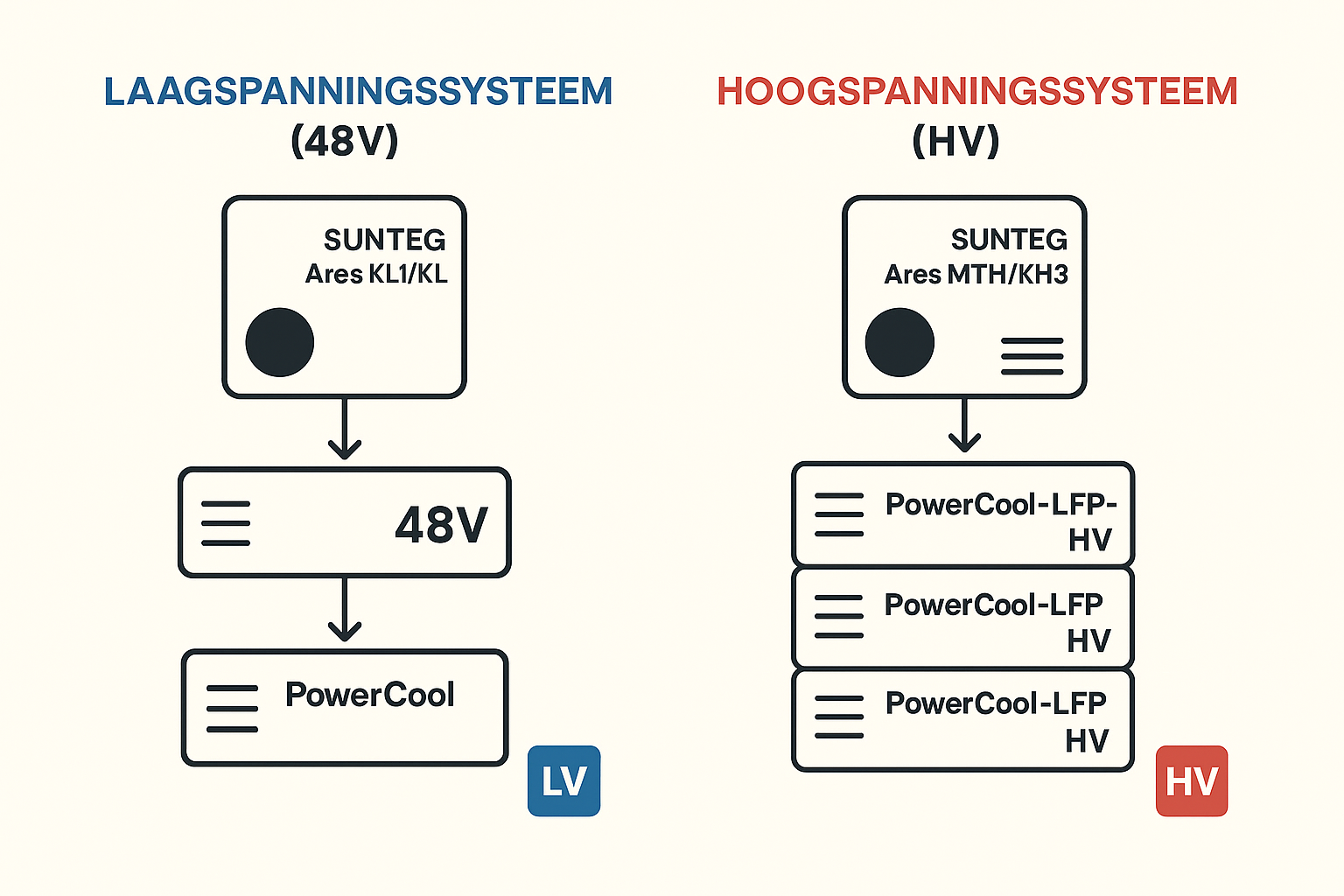
Battery Voltage & Series Compatibility
Once you know the phase of your grid connection, the next choice is the battery type. For single-phase systems (Ares KL1/KL), you choose a Low Voltage (LV) battery with an operating range of 40-60 Volts (often 48V nominal). These inverters are specifically designed for this battery type. For three-phase systems, you use the PowerCool-LFP-HV High Voltage battery. The choice between the Ares MTH and KH3 series then depends on the number of PowerCool packs:
- The Ares MTH series (3-15kW) works with a battery voltage range of 80V to 600V and is therefore compatible with systems containing at least 2 PowerCool packs.
- The Ares KH3 series (15-30kW) requires a higher battery voltage range of 150V to 800V. It is therefore only compatible with systems containing at least 3 PowerCool packs. This step ensures that the chosen inverter series is electrically compatible with your selected battery (configuration).
Power and PV Alignment
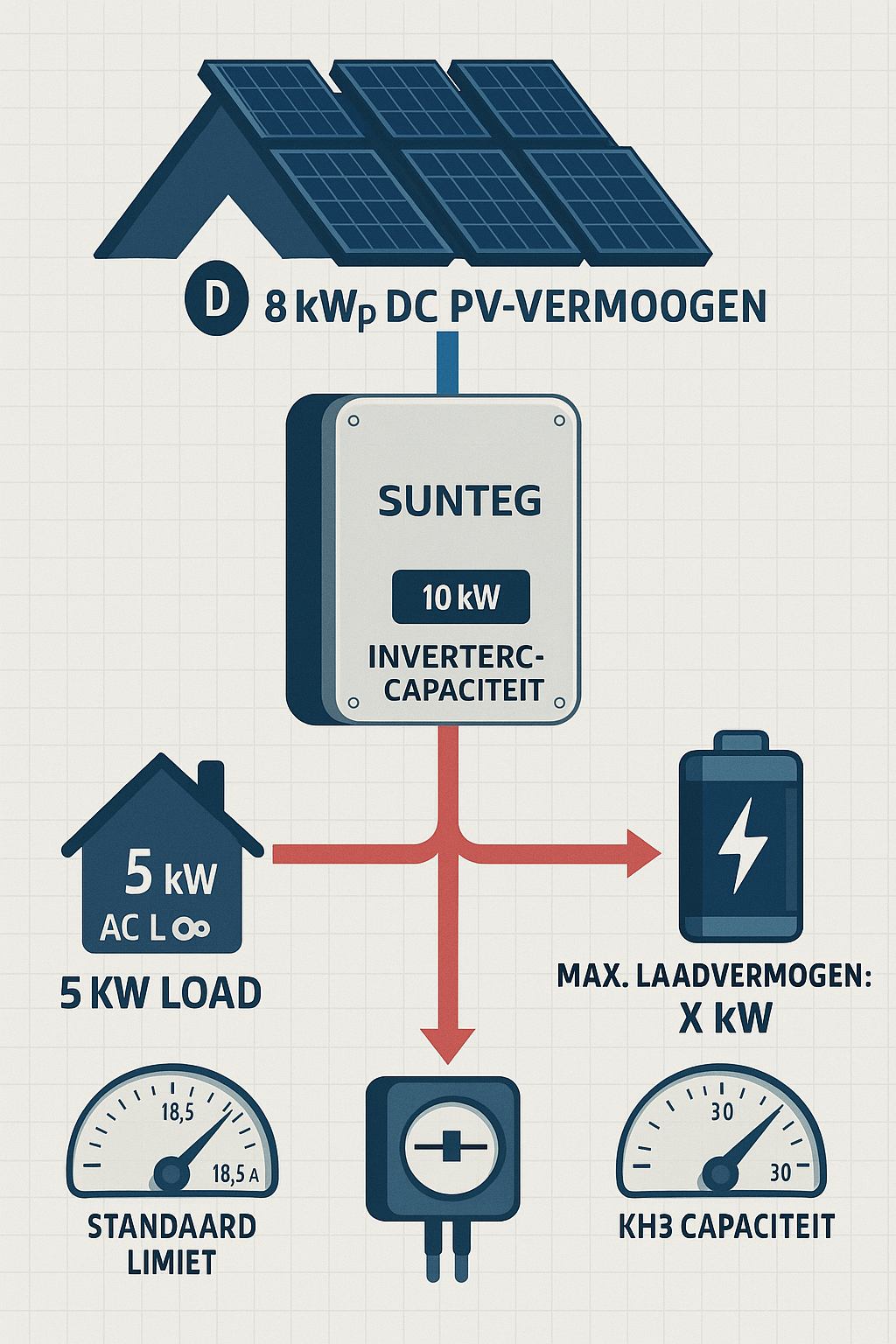
AC Requirement, PV Size & Current
Now that you know the correct inverter series, select the specific power variant. First, determine your maximum AC power requirement (kW); the inverter's Rated AC Output Power must cover this. Next, look at your solar panel installation. The total peak power of your panels (kWp) must fall within the inverter's Max. DC Input Power (often ~1.5x the AC power). Also check the maximum current per PV string (Amps):
- Ares KL1/KL (1-phase LV): Maximum 18.5A per string.
- Ares MTH (3-phase HV): Maximum 18.5A per string.
- Ares KH3 (3-phase HV): Suitable for higher currents (>18.5A, up to 40A depending on the model). This is a reason to choose KH3 (provided at least 3 PowerCool packs) if your panels have a high current that MTH cannot handle.Finally, if you have a 1-phase system and PV panels on different roof surfaces, consider the Ares KL series (with 2 MPPTs) over the KL1 (1 MPPT) for optimal yield.
Finalize Model

Verify Specifications & Compatibility
You now have a clear direction: a specific series (KL1, KL, MTH, or KH3) and an indication of the required power. Select the variant (e.g., 3kW, 5kW, 10kW) within that series that best suits your AC needs and whose Max DC Input Power can handle your PV installation. Consider the Max Charge/Discharge Power (kW) of the inverter if the speed at which the battery is charged is important; this is often equal to the nominal AC power. Check the physical dimensions and the IP protection rating (e.g., IP65 for KL/KH3, IP66 for MTH) to ensure they fit the installation location. As a very last step, always verify through the official Sunteg documentation whether there is proven communication compatibility between the chosen inverter and the Battery Management System (BMS) of your battery.

- Regular price
- €2.949,00 - €4.899,00
- Sale price
- €2.949,00 - €4.899,00
- Regular price
-

- Regular price
- €1.599,00 - €2.429,00
- Sale price
- €1.599,00 - €2.429,00
- Regular price
-